GetSafety Gear
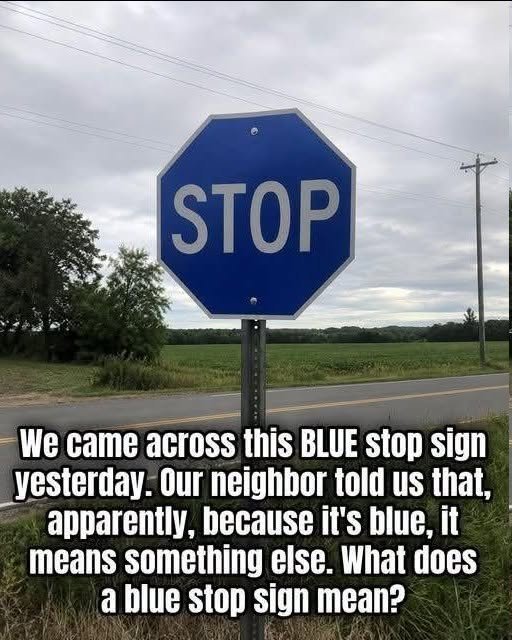
Because a blue stop sign does not meet MUTCD specifications, you
will almost never find one installed by a state or city department of transportation on a public street. Instead, they appear on private property, commercial developments, or specialized multi-use recreation trails.
Get Safety Gear
Where You Are Most Likely to Spot One
Private landowners and institutional property managers have far more freedom when ordering outdoor fixtures. As a result, non-standard signs crop up in a few distinct environments:
Learna Language
Gated Communities and HOAs: Many homeowner associations
prefer a softer, customized look that matches neighborhood streetlights and wrought-iron fencing rather
than bright municipal red.
Commercial Parking Plazas: Shopping centers and business parks use private signage to organize internal lane flow and protect pedestrian crosswalks.
University and Corporate Campuses: Large campuses often order custom signs featuring school colors or company branding palettes.
Multi-Use State Park Paths: Some regional parks use smaller blue octagons along paved bike trails to remind cyclists and pedestrians to yield before crossing maintenance roads.
Are Blue Stop Signs Legally Enforceable?
City police and state troopers generally do not enforce municipal traffic codes on private property unless the
property owner has signed a specific enforcement agreement with local authorities. A security guard at a private community might write an internal neighborhood fine, but it does not carry points against your state driver’s license.
LearnRoad Rules
A Critical Rule for Drivers: Just because a sign lacks city backing does not give you permission to ignore it. If you breeze past a blue sign
in a private parking lot and collide with another vehicle, insurance adjusters and civil courts will almost certainly find you at fault for failing to exercise
ordinary care.
From a safety standpoint, the prudent move is simple: always treat a blue stop sign exactly like a standard red one. It was placed at that intersection because someone recognized a blind curve, a busy
Find Police Jobs
crosswalk, or a dangerous blind spot.
Why Standard Stop Signs Are Red (A Short History)
Seeing an unusual blue sign often makes people appreciate how consistent our regular road system really is. That uniformity took decades to build.
When the first stop signs appeared in Detroit around 1915, they were small, square, and black-and-white. In the 1920s, traffic engineers switched the background to bright yellow with black letters. Yellow was chosen simply because early paint manufacturers could not make a weather-resistant red paint that stayed bright and reflective under
car headlights at night.
By 1954, advancements in synthetic reflective sheeting solved the fading problem. Transportation officials updated the national manual to require red stop signs across the country. Red was already linked
to stoplights, train signals, and universal danger warnings, making it the most sensible choice for high-stakes intersections.
Decoding Unusual Road Sign Colors
While blue stop signs are unofficial novelties, the federal MUTCD color code does assign specific meanings to standard sign colors across the country. Understanding these colors keeps you alert on long family road trips:
Blue
Signs: On public highways, blue rectangles provide traveler services and information, pointing you toward rest stops, gas stations, hospitals, and campgrounds.
Fluorescent Pink Signs: Used specifically for incident management. When an unexpected crash
or natural disaster closes a lane, responders use pink signs to set up emergency detours.
Fluorescent Yellow-Green Signs: Reserved strictly for pedestrian crosswalks, bicycle paths, and school safety zones where extra daytime brightness prevents accidents.
Brown Signs: Designate cultural sites, historic landmarks, national parks, and public recreational areas.
Purple Signs: Designated specifically for electronic toll-collection lanes.
Installing
Custom Signs on Private Property
If you own a long private driveway, run a small farm, or manage an HOA board, you might consider installing your own signage to slow down delivery trucks
and visitors. While putting up custom colors is tempting, there are a few practical rules to keep in mind.
For Complete Cooking STEPS Please Head On Over To Next Page Or Open button (>)