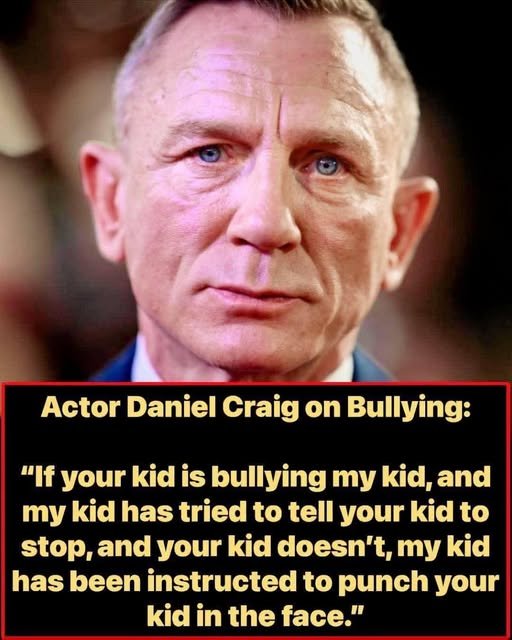
A few words can sometimes start a much bigger conversation than anyone expects. A statement circulating online and attributed to British actor Daniel Craig has recently drawn attention to one of the most difficult challenges many families face: how should parents teach their children to deal with bullying?
The image features Craig alongside a powerful message about standing up to bullies. It suggests that if a child repeatedly bullies another child, even after being asked to stop, the victim should be prepared to defend themselves.
The message has attracted attention because it touches on a subject that many parents feel strongly about. While some people believe children should never respond to aggression with physical force, others argue that children should not be expected to remain passive when someone repeatedly mistreats them.
However, the exact wording in the circulating image has not been independently verified as an authentic Daniel Craig quotation. What makes the discussion particularly interesting is the important issue behind the viral message.
Why the Message Has Attracted So Much Attention
Bullying is an issue that affects children in schools, playgrounds, neighborhoods, and increasingly through digital communication.
For many parents, discovering that their child is being bullied can be deeply upsetting. They naturally want to protect their children and make sure they feel safe, confident, and respected.
The message attributed to Daniel Craig reflects a straightforward parenting philosophy: children should understand that they deserve respect and should not feel powerless when someone repeatedly targets them.
Some parents identify with this approach because they believe children need confidence and the ability to establish personal boundaries.
Others, however, question whether encouraging physical retaliation could make an already difficult situation worse.
This difference in opinion explains why the image has become an interesting starting point for conversations about parenting, discipline, and childhood behavior.
Understanding the Difference Between Self-Defense and Aggression
One of the most important parts of the bullying discussion is understanding that defending yourself and deliberately hurting someone are not the same thing.
Children should learn that they have the right to feel safe and that nobody should repeatedly threaten, intimidate, or physically harm them.
At the same time, teaching children to respond to every disagreement with violence can create additional problems.
A child who experiences bullying needs guidance that helps them recognize dangerous situations, communicate their feelings, and seek appropriate support.
Self-defense should always be understood as protecting oneself from immediate harm rather than seeking revenge or punishing another child.
Parents can help children understand these differences through everyday conversations and practical examples.
Why Parents Are So Concerned About School Bullying
School is supposed to be a place where children develop knowledge, friendships, confidence, and important social skills.
Unfortunately, not every child experiences school in the same way.
For some students, repeated teasing, exclusion, intimidation, or aggressive behavior can make everyday activities stressful.
Bullying is not limited to physical confrontations. It can also involve hurtful comments, embarrassing someone in front of classmates, spreading rumors, deliberately excluding someone, or sending threatening messages online.
Sometimes these experiences are difficult for adults to recognize because children may feel uncomfortable discussing what is happening.
They might worry that speaking up will make the situation worse or that their classmates will treat them differently.
That is why creating an environment where children feel comfortable talking to their parents is so important.
How Parents Can Help Children Deal With Bullies
For Complete Cooking STEPS Please Head On Over To Next Page Or Open button (>)